
Cannabis under LED lighting performs best at roughly 72–77°F and 65–75% humidity for seedlings, 70–85°F and 55–70% in veg, and 68–80°F dropping to 40–50% humidity in flower — targeting a VPD of 0.4–0.8 kPa early, 0.8–1.2 kPa in veg and 1.2–1.6 kPa in bloom. LED rooms usually need to run warmer than HPS rooms to hit the same transpiration rate.
That last detail catches out a lot of growers switching from HPS. Below is the full stage-by-stage chart, why LEDs change the maths, and how to diagnose a room that is fighting you.
The Complete Environment Chart
Print this one. It covers every stage from propagation through to late flower.
| Stage | Temperature (lights on) | Relative humidity | Target VPD |
|---|---|---|---|
| Clones / seedlings | 72–77°F | 65–75% | 0.4–0.8 kPa |
| Early vegetative | 70–85°F | 60–70% | 0.8–1.0 kPa |
| Late vegetative | 70–85°F | 55–65% | 1.0–1.2 kPa |
| Early flower | 68–80°F | 45–55% | 1.2–1.4 kPa |
| Mid flower | 68–78°F | 45–50% | 1.3–1.5 kPa |
| Late flower | 65–75°F | 40–50% | 1.4–1.6 kPa |
Keep a 10–15°F gap between lights-on and lights-off temperatures. Too small a differential and you lose the signal plants use to regulate stretch; too large and you risk condensation on cold surfaces.
What VPD Actually Measures
Vapour pressure deficit is the difference between how much moisture the air is holding and how much it could hold at that temperature. It is a single number that captures what temperature and humidity do together.
Practically, VPD tells you how hard the plant is being pulled to transpire. Too low and transpiration stalls, taking nutrient uptake with it. Too high and the plant closes its stomata to protect itself, which also stops growth.
This is why chasing temperature and humidity as separate numbers leads growers in circles. 78°F at 60% humidity and 72°F at 70% humidity are very different environments for a plant, even though neither reading looks alarming on its own.
VPD collapses both into one figure you can actually steer by. Once you start managing the room by VPD rather than by two independent dials, most environmental problems become obvious.
| VPD reading | What is happening | Visible symptoms |
|---|---|---|
| Below 0.4 kPa | Transpiration stalled | Slow growth, guttation, edema, mould risk |
| 0.8–1.2 kPa | Healthy vegetative transpiration | Vigorous growth, strong turgor |
| 1.2–1.6 kPa | Ideal flowering range | Tight internodes, good resin development |
| Above 1.8 kPa | Plant defensively closing stomata | Leaf curl, wilting, stunted growth |
Why LED Rooms Are Different
This is the part that trips up growers coming off HPS. LEDs emit far less infrared radiation than HPS lamps, so they do not warm the leaf surface the same way.
Under LEDs, leaf temperature typically runs about 2–3°C (roughly 4–5°F) cooler than the surrounding air. Under HPS, leaves often sit warmer than ambient.
The consequence: if you set an LED room to the ambient temperature you used under HPS, your leaves are colder, your leaf-level VPD is lower than your meter suggests, and transpiration underperforms. Most LED growers need to run ambient a few degrees warmer to compensate.
| Factor | HPS rooms | LED rooms |
|---|---|---|
| Infrared output | High | Low |
| Leaf vs air temperature | Leaf warmer than air | Leaf 2–3°C cooler than air |
| Ideal ambient temperature | Lower | Higher to compensate |
| Room heat load | Very high | Lower — may need supplemental heat |
| Humidity control burden | Dehumidification heavy | Often needs humidification in veg |
| VPD calculation | Air temp approximates leaf temp | Must offset leaf temperature |
For the underlying science of controlled environment growing, Cornell University’s Controlled Environment Agriculture programme publishes well-regarded research on greenhouse and indoor crop environments.
Measuring It Properly
- Measure at canopy height, not at the wall where your controller happens to hang.
- Use an infrared thermometer to read actual leaf surface temperature.
- Take multiple readings — corners and centre often differ by several degrees.
- Log over time. A single spot reading hides the swings that actually cause problems.
- Calculate VPD from leaf temperature, not air temperature, for accuracy under LEDs.
Late Flower: Where Quality Is Won or Lost
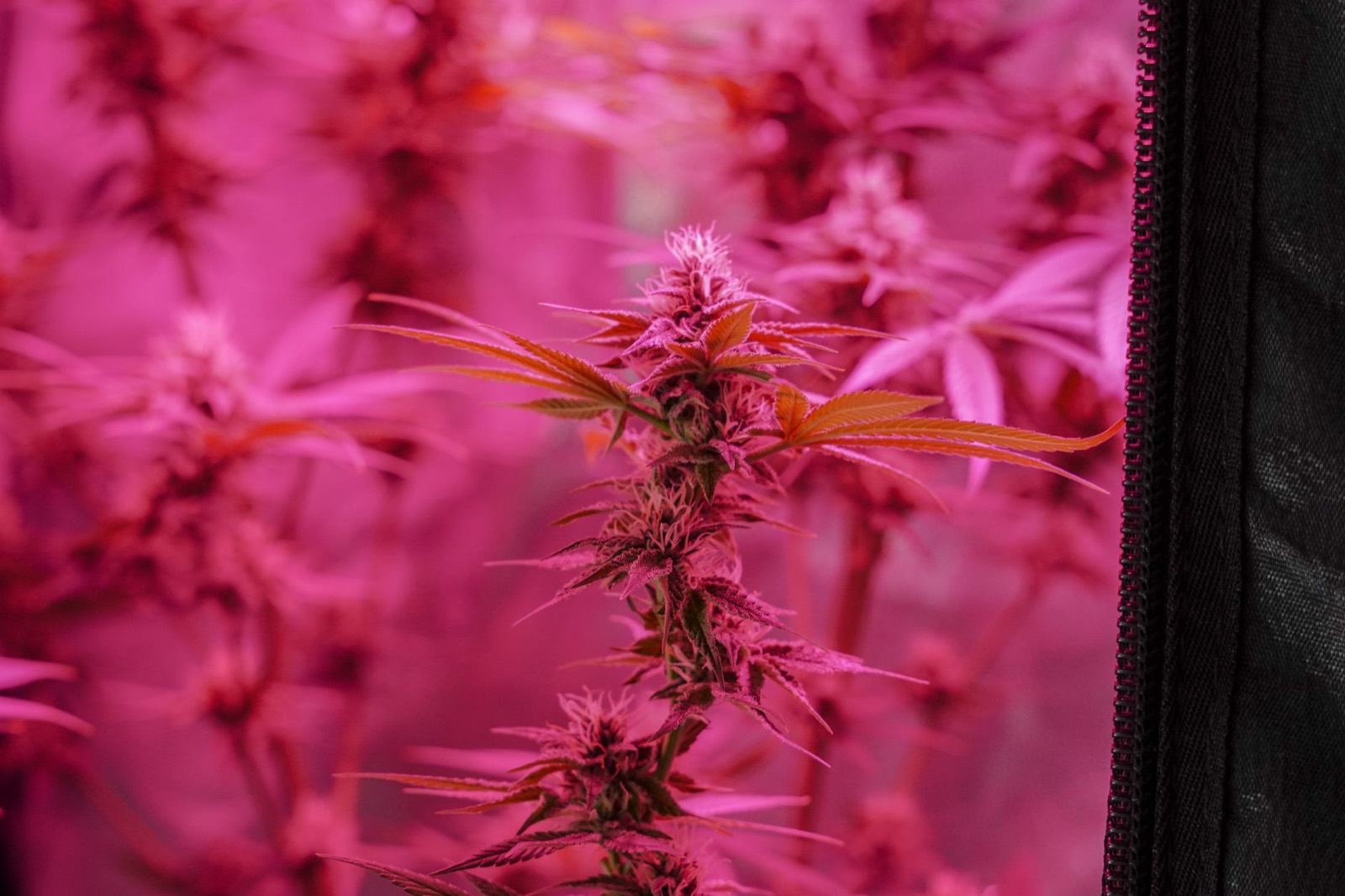
The back half of bloom is the highest-stakes period in the room. Dense flower plus high humidity is how botrytis starts, and terpene retention falls off sharply if the environment drifts.
- Bring humidity down to 40–50%. This protects against bud rot in dense colas.
- Drop temperature slightly. Cooler late flower helps preserve volatile terpenes.
- Keep air moving. Airflow through the canopy matters as much as the numbers.
- Do not spike VPD suddenly. Gradual change; plants adapt poorly to shocks.
This matters most on tight, resinous cultivars. Our Sake Bomb Gelato 33 × Sherbanger selection and Kiwano tropical melon cultivar both throw dense flower, and both are grown without sterilizers — which means environmental control does the work chemicals otherwise would.
Troubleshooting a Room That Is Fighting You
| Symptom | Likely environmental cause | Correction |
|---|---|---|
| Leaf edges curling up | VPD too high, heat stress | Lower temperature or raise humidity |
| Droopy, heavy leaves | VPD too low, overwatering | Raise temperature or dehumidify |
| Water droplets on leaf edges | Guttation from very low VPD | Increase transpiration demand |
| Slow growth despite good feed | Transpiration stalled | Check leaf-level VPD, not air |
| Bud rot in late flower | Humidity too high, poor airflow | Dehumidify, add canopy airflow |
| Foxtailing buds | Excess heat at canopy | Raise lights or reduce intensity |
How We Run Our Room
Lost Leaf flower is grown in a 1,000 square foot facility beside the Manistee National Forest, combining hydroponic control with organic inputs on a nutrient program built from scratch.
Because we use no pesticides and no sterilizers, environment is the primary defence. Every cultivar is hunted from seed in-house and the room is tuned for flavour, smoothness and smokability rather than raw yield.
The full protocols live in our grow document on ideal room conditions for LED cultivation, with companion guides on cannabis nutrients and feeding schedules and plant training techniques. Growers starting from propagation should read our comparison of rockwool and aeroponic cannabis cloning first.
Frequently Asked Questions
What is the ideal temperature for a cannabis grow room with LEDs?
Roughly 72–77°F for seedlings, 70–85°F in vegetative growth, and 68–80°F in early flower dropping to 65–75°F late. LED rooms generally run warmer than HPS rooms because LEDs emit less infrared.
What VPD should cannabis be grown at?
Around 0.4–0.8 kPa for seedlings and clones, 0.8–1.2 kPa in vegetative growth, and 1.2–1.6 kPa in flower, with the higher end used late in bloom to reduce moisture.
Why are my leaves cooler than the room under LED?
LEDs emit far less infrared radiation than HPS, so they do not heat the leaf surface directly. Leaf temperature typically runs 2–3°C below ambient, which lowers your true leaf-level VPD.
What humidity should late flower be?
40–50%. Bringing humidity down through the back half of bloom protects dense flower from botrytis and helps preserve terpene content.
Should I measure air or leaf temperature for VPD?
Leaf temperature, measured with an infrared thermometer at canopy height. Under LEDs, calculating VPD from air temperature alone overstates your actual transpiration rate.
Educational content for adults 21+ growing legally in their jurisdiction.
Related reading: Cannabis nutrients, npk ratios and deficiency diagnosis. Harvesting, drying and curing cannabis. Plant training techniques that change canopy airflow.
Related reading: How climate control determines pest pressure. Irrigation, runoff and EC management.